
The best wall paint is a product suited to the surface and room, with a sheen, colour and cleaning performance that meet your needs. Start by comparing water-based paints formulated for interior walls, then check the product data, existing coating, moisture and preparation requirements. A label such as acrylic, emulsion or silicone alone does not establish quality or suitability.
Prepared by SMD Decoration · Content and references updated: 9 October 2026

How do you choose the right wall paint before buying?
- Identify the surface: plaster, plasterboard, concrete or an existing coating. Do not use an ordinary wall paint on wood or metal without product approval.
- Identify indoor or outdoor use, traffic and cleaning frequency.
- Inspect leaks, peeling and stains before selecting the finish.
- Request the full product name, Technical Data Sheet (TDS) and Safety Data Sheet (SDS), rather than a marketing family alone.
- Approve a colour and sheen sample in the room. Compare the complete system cost, including preparation, primer and labour.
Water-based, oil-based, acrylic and silicone paints explained
These names do not always describe separate categories. A water-based wall paint may be acrylic or acrylic latex. The Arabic market term “plastic paint” often means an emulsion paint; it should not be translated as a coating for plastic. Compare the formulation and declared application on the product.
Sherwin-Williams describes soap-and-water tool cleanup for latex and oil/alkyd products for selected high-traffic trim [1]. Drying, odour and resistance vary by product. Oil-based paint is not automatically longer-lasting or the best choice for every wall.
Silicone can describe an additive in an interior water-based product. Filli Boya documents one such vinyl-acrylic interior formulation [6]. Check the actual application; this name alone does not establish waterproofing, mould remediation or exterior suitability.
| Family or description | Potential application | Check before choosing |
|---|---|---|
| Water-based emulsion / acrylic latex | Interior walls as declared by the product | Washability, sheen, substrate and primer |
| Oil / alkyd | Trim, doors or other declared surfaces | Compatibility, drying, cleanup and ventilation |
| Silicone or silicone-modified | A specified indoor or outdoor use | Full product classification |
| Matt, satin or gloss | A finish within different paint families | Cleaning performance and surface imperfections |
Should you choose matt, satin or gloss wall paint?
Sheen describes reflected light, not a chemical family. Matt finishes can make surface flaws less apparent; high gloss can emphasise them. Washability varies even within one sheen. Specialist matt products exist for humid rooms, so check declared performance instead of assuming higher gloss is always better [2].

Choosing wall paint by room
| Area | Practical priority | Purchase decision |
|---|---|---|
| Bedrooms and living rooms | Appearance, coordination and maintenance | Interior water-based product with appropriate finish and performance |
| Hallways and children’s rooms | Frequent contact and cleaning | Documented wash resistance and cleaning instructions |
| Kitchens and bathrooms | Moisture, ventilation and substrate | Product approved for these conditions after the moisture cause is addressed |
| Exterior façade | Sun, rain and substrate | Exterior system; do not substitute an interior coating |
Mould control begins with moisture control. EPA advises dealing with the cause and cleaning and drying the surface before painting; paint over mould can peel [4]. Repair leaks or ventilation problems before buying a new colour. A mould-resistant label is not a promise to repair the underlying problem.

How do you choose a colour for the light and space?
Shortlist shades that work with the flooring, doors and furniture. Compare neighbouring samples in the same area in daylight and in the room’s evening lighting, then approve both colour and sheen.
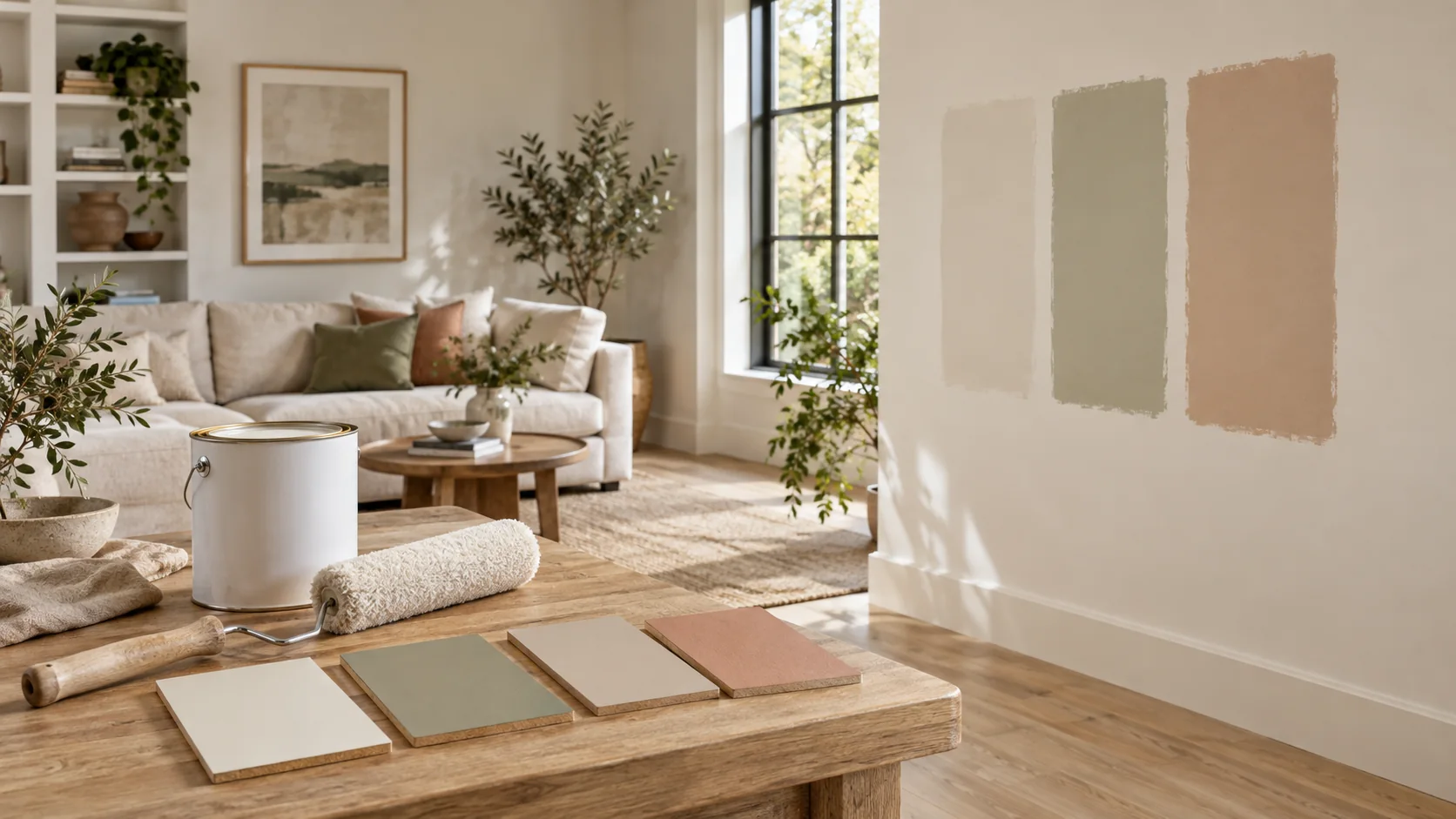
Jotun explains that lighting, surrounding materials, sheen and substrate affect colour appearance; screen colours can differ from application [3]. Use a physical sample and test an actual coat. The illustrations here help you explore coordination.

How do you estimate paint quantity and compare cost?
Measure the surfaces to be painted and handle openings under the agreed measurement method. Where the declared coverage is per coat, theoretical litres = area × coats ÷ coverage per litre. Check the unit: some specifications describe coverage for the complete system.
Illustrative calculation: 38 m², two coats and 10 m²/litre per coat give 7.6 theoretical litres, before adjusting for absorption, waste and pack sizes. This is not a particular product’s coverage or a price quote. Compare proposals specifying product, primer, preparation, coats, protection and cleanup.

Wall preparation and paint application
- Inspect the wall and existing coating and address the cause of moisture or peeling.
- Clean and dry the surface and repair appropriate defects. Inspection determines which old coating can remain and which needs removal.
- Specify a compatible primer for the substrate and topcoat. Options address porosity, stains and adhesion [5].
- Approve the sample, then use the coats, dilution and tools specified in the product data.
- Follow ventilation, protective-equipment, handling and disposal instructions. Do not mix products or dilute with an unapproved material.
- Distinguish the recoat interval from the time needed to achieve final cleaning properties. Read the instructions before using the room or washing the wall.
Old paint removal is not indiscriminate power sanding. Have old or unknown coatings assessed before disturbing them; EPA warns that renovation of lead-containing paint can create hazardous dust [7]. A qualified professional should determine preparation suited to the surface, material and site.
Mistakes that make paint comparisons misleading
Avoid comparing pack prices without coverage and units, treating a marketing name as an assurance, choosing colour only on a phone or using one drying time for every product. Keep the product name, colour code, sheen and pack information for later maintenance.
Related guides for paint types and application
- Wall Paint Types: Advantages, Limitations and How to Choose
- Oil-Based Paint: Uses, Limitations and Application Steps
Technical sources and verification
- Sherwin-Williams — How to Choose Interior Paint
- Benjamin Moore — Choosing a Paint Finish
- Jotun — Colour samples
- US EPA — Basic mold cleanup steps
- Sherwin-Williams — How to Choose Primer
- Filli Boya — Expert Silikonlu Mat İç Cephe Boyası
- US EPA — Lead-safe renovations for DIYers
Start your dream project today with SMD Decoration
Your space, your vision. SMD Decoration offers interior design, fit-out and renovation in Turkey and Arab markets: homes, apartments, villas, offices, hotels, restaurants, healthcare, education and exhibitions. Reflect your identity, needs and budget.
Explore finishes, painting, upholstery, custom furniture and lighting in modern, classic, contemporary, industrial or eco-conscious styles. Agree services, execution details and handover before work.
SMD Decoration websites
- Main website: smddecoration.com
- Turkey: smddecoration.net.tr
- Oman, Kuwait & Bahrain: turkiyedecoration.com
- Qatar: smddecoration.qa
- UAE: smddecoration.ae
- Saudi Arabia: smddecoration.sa
- Saudi Arabia — additional site: smddecoration.net
- Libya: smddecoration.info
- Iraq: smddecoration.site
- Syria: smddecoration-syria.com
SMD accepts conventional currencies and bank transfers; Bitcoin and other cryptocurrencies are not accepted.
Bring your vision to life with SMD
Share the city, photos and area of the walls, the existing coating condition and your preferred colours. Discuss finishes, preparation, execution and handover with SMD Decoration to receive a proposal suited to your project.
Email: info@smddecoration.com
Project enquiry